Balancing pH Level in Hydroponic Systems | Best Hydroponics
Balancing pH in hydroponic systems is crucial for optimal plant health and maximum yields. The article discusses the importance of maintaining proper pH levels, typically between 5.5 and 6.0 for most crops, to ensure optimal nutrient availability and uptake. It explores how pH affects nutrient solubility and plant absorption, emphasizing that incorrect pH can lead to nutrient lockout, deficiencies, or toxicities. Factors influencing pH in hydroponic systems include nutrient concentration, growing media, organic matter, water quality, and environmental conditions.
The article outlines various pH testing methods, from simple test strips to advanced automated monitoring systems, and discusses adjustment techniques using commercial or natural products. It also touches on advanced pH management techniques involving AI and IoT. While highlighting the benefits of proper pH management, the article acknowledges challenges such as cost, complexity, and potential over-reliance on technology. Overall, it emphasizes the critical role of pH balance in successful hydroponic cultivation.
#1 Recommended Hydroponic Smart Kit | #2 Recommended Hydroponic Smart Kit |
 |  |
Balancing pH in Hydroponic Systems for Optimal Plant Health
In the world of hydroponic cultivation, maintaining the proper pH balance is crucial for ensuring optimal plant health and maximizing yields. pH, which measures the acidity or alkalinity of a solution, plays a vital role in nutrient availability and uptake in soilless growing systems. This article delves into the importance of pH management in hydroponics, its effects on plant growth, and the best practices for maintaining optimal pH levels.
Understanding pH in Hydroponics
The pH scale ranges from 0 to 14, with 0 being extremely acidic, 7 neutral, and 14 extremely alkaline. In hydroponics, most crops thrive in a slightly acidic environment, with an optimal pH range of 5.5 to 6.0. This range generally provides the best balance for nutrient availability and uptake for a wide variety of plants.
However, it’s important to note that different plants may have specific pH requirements. For instance, blueberries prefer more acidic conditions (pH 4.0-5.0), while crops like kale and peas favor slightly higher pH levels (6.0-7.0). Understanding these specific needs is crucial for optimizing growth and yield in hydroponic systems.
The Impact of pH on Nutrient Uptake
pH directly affects the solubility and ionic form of nutrients in the solution. At optimal pH levels, nutrients are in forms that plants can easily absorb through their roots. However, incorrect pH levels can lead to nutrient lockout, where plants cannot absorb available nutrients, resulting in deficiencies or toxicities that can severely impact plant health and yield.
Macronutrients like nitrogen and potassium are generally available across a wider pH range, while micronutrients like iron and manganese are more sensitive to pH changes and may become unavailable at higher pH levels. For example, iron deficiency often manifests as yellowing leaves (chlorosis) in young plants when pH is too high, while calcium deficiency, common in low pH environments, can cause leaf cupping and tip burn.
Factors Affecting pH Levels in Hydroponic Systems
Several factors can influence pH levels in hydroponic systems:
- Nutrient solution concentration: As plants absorb water and nutrients, the solution becomes more concentrated, potentially altering the pH.
- Growing media: Some media, like gravel, can act as pH buffers, gradually releasing minerals that affect the pH of the nutrient solution.
- Organic matter: Algae growth and bacterial activity can cause pH fluctuations throughout the day.
- Water quality and hardness: Hard water can increase pH and make it more resistant to change, while soft or purified water may be more prone to fluctuations.
- Environmental factors: Higher temperatures can lower pH, while increased CO2 levels can cause pH to drop as carbonic acid forms in the solution.
pH Testing and Monitoring
Regular pH testing is essential for maintaining optimal growing conditions. Various methods are available for pH testing in hydroponics:
- Test strips and liquid test kits: Affordable and easy-to-use options for small-scale growers.
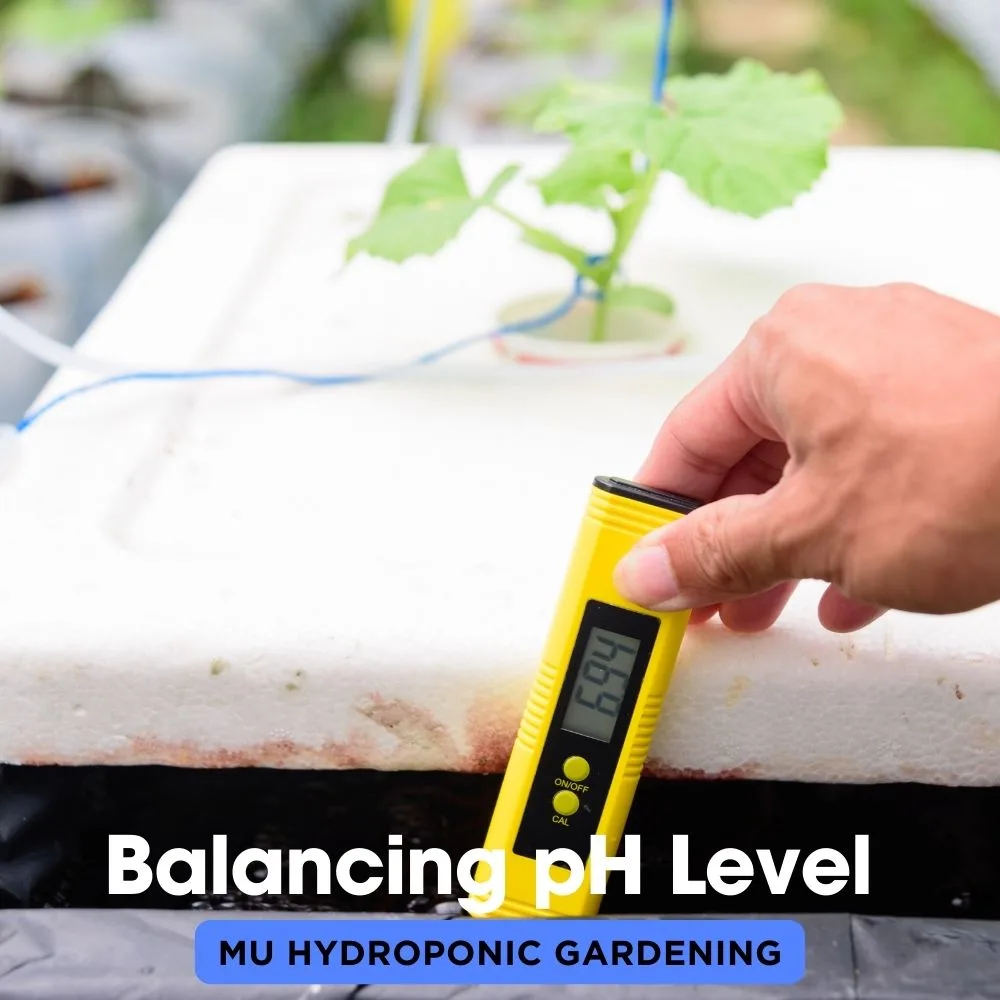
- Digital pH meters: Offer more accurate and consistent readings, ideal for larger operations or where precise pH control is crucial.
- Automated pH monitoring systems: Continuously monitor pH levels and can be integrated with dosing pumps for automatic adjustments, ideal for large-scale operations.
For most hydroponic systems, daily pH testing is recommended to catch changes early. More frequent testing may be needed after nutrient adjustments or in systems prone to fluctuations.
Adjusting and Maintaining pH Levels
When pH levels deviate from the optimal range, adjustments are necessary. Commercial “pH Up” and “pH Down” solutions are available for raising or lowering pH levels, respectively. These products are typically based on potassium hydroxide or phosphoric acid.
For small-scale or organic systems, natural acids like vinegar or citric acid can be used to lower pH, while baking soda can raise it. However, these natural methods may affect nutrient balance and are less precise than commercial products.
When adjusting pH, it’s crucial to make gradual changes to avoid shocking the plants. Rapid adjustments may be necessary in emergencies but can stress plants if done too quickly.
Advanced pH Management Techniques
As hydroponic technology advances, new methods for pH management are emerging:
- AI and IoT in hydroponic pH management: Advanced systems use artificial intelligence and Internet of Things technology to predict pH changes and automate adjustments.
- Integrating pH control with EC (electrical conductivity) management: pH and EC are interconnected; managing both simultaneously is crucial for optimal nutrient availability and plant health.
- Automatic pH controllers: These devices continuously monitor pH and automatically adjust it, maintaining optimal levels with minimal human intervention.
Downsides and Challenges
While precise pH management is crucial for hydroponic success, it does come with some challenges:
- Cost: Accurate pH meters and automated systems can be expensive, especially for small-scale growers.
- Complexity: Maintaining proper pH requires knowledge and constant attention, which can be overwhelming for beginners.
- Over-reliance on technology: Automated systems can fail, potentially leading to crop loss if not monitored.
- Chemical use: Frequent pH adjustments may require the use of chemicals, which some organic growers may want to avoid.
- Water waste: Frequent adjustments and system flushes to correct pH imbalances can lead to increased water usage.
Conclusion
Balancing pH in hydroponic systems is a critical aspect of successful cultivation. By understanding the factors that influence pH, regularly monitoring levels, and making careful adjustments, growers can ensure optimal nutrient availability and plant health. While there are challenges associated with pH management, the benefits of increased yields and healthier plants make it a worthwhile endeavor for hydroponic growers of all scales.
As hydroponic technology continues to advance, we can expect even more precise and automated methods for pH control, making it easier for growers to maintain optimal conditions for their crops. However, a solid understanding of pH principles will always remain crucial for successful hydroponic cultivation.
#1 Recommended Hydroponic Smart Kit | #2 Recommended Hydroponic Smart Kit |
| | |
Summary and FAQs
How often should I check the pH in my hydroponic system?
For most hydroponic systems, it’s recommended to check pH daily. This frequency allows you to catch any changes early and make necessary adjustments. However, you may need to check more frequently if you’ve recently made nutrient adjustments or if your system is prone to fluctuations. For large-scale or commercial operations, continuous monitoring with automated systems is often employed.
What are the consequences of incorrect pH levels in a hydroponic system?
Incorrect pH levels can lead to several issues:
- Nutrient lockout: Plants may be unable to absorb available nutrients, even if they’re present in the solution.
- Nutrient deficiencies or toxicities: Extreme pH levels can cause deficiencies in some nutrients and toxicities in others.
- Stunted growth: Plants may not grow properly or may show signs of stress.
- Reduced yield: Overall crop production can be significantly impacted.
- Root damage: Extreme pH levels can harm root systems, making plants more susceptible to diseases.
Can I use household items to adjust pH in my hydroponic system?
While it’s possible to use household items like vinegar (to lower pH) or baking soda (to raise pH), it’s generally not recommended for several reasons:
- These items can affect nutrient balance in unpredictable ways.
- They’re less precise than commercial pH adjustment products.
- They may introduce unwanted substances into your system.
- The effects may be short-lived, requiring more frequent adjustments. It’s safer and more effective to use commercial pH Up and pH Down products specifically designed for hydroponic systems.
Why does the pH in my hydroponic system keep changing?
Several factors can cause pH fluctuations in hydroponic systems:
- Nutrient uptake by plants can change the pH of the solution.
- The type of growing media used can affect pH levels.
- Algae growth or bacterial activity can alter pH.
- Water quality and hardness play a role in pH stability.
- Environmental factors like temperature and CO2 levels can influence pH. Regular monitoring and maintenance are crucial to manage these ongoing changes.
Is it better to maintain a constant pH or allow for some fluctuation in hydroponic systems?
While it’s important to keep pH within the optimal range (typically 5.5-6.0 for most crops), some slight fluctuation is natural and can even be beneficial. A slight drift within this range (e.g., 5.5 to 5.8) can help ensure a broader spectrum of nutrient availability. However, rapid or large fluctuations should be avoided as they can stress plants. The goal is to maintain a stable pH environment while allowing for minor, gradual changes that mimic natural conditions. If pH drifts outside the optimal range, it should be adjusted back gradually to avoid shocking the plants.